Itinerary
Itinerary
Day 1: Arrive in Istanbul, where Turkey’s history and living culture converge
Check in to the Pera Palace Hotel, built in 1892 for Orient Express travelers
Join your Expedition Leader for a welcome meal introducing Turkish cuisine
Arrive in Turkey's beguiling capital where you are met at the airport and transferred to the Pera Palace Hotel, opened in 1892 to host passengers arriving aboard the fabled Orient Express. The landmark hotel has lasted through the reigns of three Ottoman sultans, the fall of the Ottoman Empire, and the rise of the New Turkish Republic beginning in 1923. A paragon of Belle Epoque style, Pera Palace is defined by its Art Nouveau facade and architecture, and black-and-white portraits still hang beside marble staircases, recalling Istanbul’s late-Ottoman era. Among the hotel's many notable guests are Agatha Christie, Ernest Hemingway, Emperor Franz Joseph and Queen Elizabeth II. Get a brief taste of Istanbul's character before a welcome dinner and orientation to our Turkish adventures ahead, knowing we will return to the evocative city later in our journey.

Day 2: Encounter Rumi’s whirling dervish traditions in Konya
Visit the Mevlana Museum, where Rumi’s tomb lies beneath a turquoise-tiled dome
Meet a contemporary member of the Mevlevi Order for insight into Rumi’s teachings
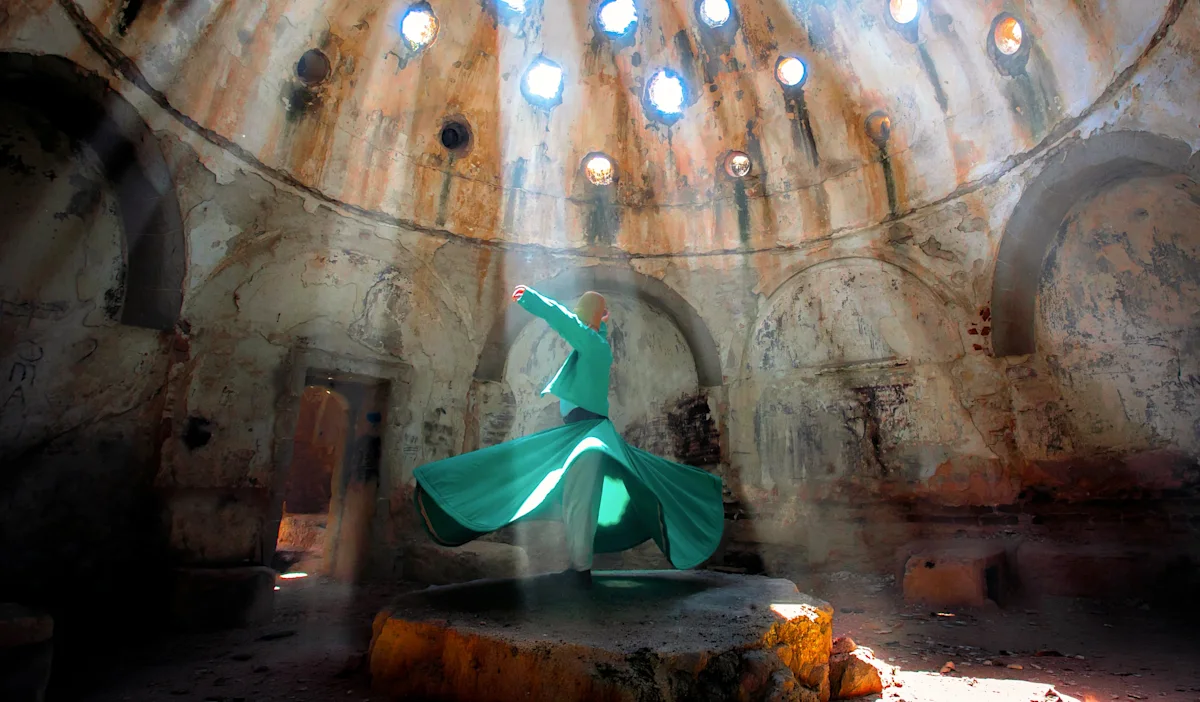
Witness a private whirling dervish ceremony of meditative prayer
Board a high-speed train to Konya this morning, heading southeast across the Anatolian Plateau. Little known on traditional Turkey tourist circuits, Konya is a spiritual center and pilgrimage destination for Sufis, focused on the tomb of 13th-century Persian poet, mystic and theologian Jelaleddin Rumi, founder of the Mevlevi Order. On arrival, we have lunch at a local restaurant before heading up to Alaeddin Hill, an important site in Konya's history. In the 11th century, Konya became the capital of the great Seljuk Empire, and the citadel erected here in the 1220s offers a panoramic view over the city.
We visit the Mevlana Museum, center of the religious order founded by followers of Rumi, whose poetry and teachings helped spread Sufi practice across the Islamic world. Rumi’s mauseoleum lies beneath the museum’s turquoise-tiled dome, while exhibits showcase an impressive collection of Rumi's personal belongings, manuscripts and artifacts. Continue to Hichane Lodge, a center for Sufi practice, for a private meeting with a contemporary member of the Mevlevi Order who offers insight into the spiritual traditions that grew from Rumi’s teachings. Witness a private whirling dervish ceremony, where Sufi practitioners perform the Sema, an ecstatic dance where they spin continuously in a form of active meditation and prayer to achieve a state of spiritual union with God. Rumi believed that music, poetry and dance were pathways to the divine, and while this is a folkloric performance, the experience feels transcendent. This evening, convene for dinner at a special restaurant overlooking the Mevlana Museum, built in the style of traditional Konya houses.

Day 3: Return to a private dervish lodge for devotional music
Hear a private concert rooted in the spiritual traditions of Rumi and the Mevlevi Order
Sample natural wines made from revived Anatolian grapes and aged in clay jars
Visit Byzantine churches carved from and built with Cappadocia’s volcanic stone
Return to Hichane Lodge for a Sufi concert this morning, then depart by road for Cappadocia, about three hours to the northeast. En route, lunch is served during our private visit to Gelveri, a small winery set in a 250-year-old rock-carved Greek house in Guzelyurt, one of the world's highest grape-growing regions at nearly 5,000 feet. Along with our meal, sample several wines, discovering why the owners have gained acclaim for their historic sustainable production methods. Among Turkey's 1,400 grape varieties, they are reviving ancient grapes to create 100% natural wines using only wild yeasts, with no added sulfites. Wines are aged in traditional Anatolian clay jars, a method that dates to the Roman era. Many of the jars, called kups, date from the 4th to 12th centuries and come from Byzantine monasteries in Cappadocia. Micro-producer Gelveri is renowned for its amber wines, crafted using indigenous and rare Anatolian white grapes with the skins left on.
After lunch, we visit two distinctive churches: The High Church, believed to have been a nunnery, includes rock-cut rooms, cisterns and retreats carved into towering rock faces. The Red Church is one of the oldest in Cappadocia, dating to the 5th or 6th century, the era of Byzantine Emperor Justinian. Unlike most of the famous cave churches, this striking structure capped with a dome is freestanding, built of local volcanic red stone. The Cappadocia region of Central Anatolia is replete with hundreds of churches and monasteries, evidence of its status as an important center of early Christian learning and practice. Its subterranean cities are also well known, dug to offer protection to Christians during periods of persecution. In addition to its rock-cut churches and ancient troglodyte cave complexes, Cappadocia is famous for its "fairy chimney" rock formations—volcanic hoodoos created by centuries of erosion, with portions protected as a UNESCO World Heritage Site.

Day 4: Cook with a women’s cooperative and explore Cappadocia’s underground city
Descend into Mazı Underground City to see its rock-cut chambers, wells and rolling stone doors
Learn Anatolian family recipes during a hands-on cooking class at a women’s cooperative
Walk the Greek Orthodox lanes of Mustafapasa before a Michelin-starred meze dinner
There's no more iconic image of Cappadocia than the sight of dozens of bright hot air balloons floating over the fairy chimneys and volcanic valleys at sunrise, and those who wish will have an opportunity for that experience this morning (additional cost). Later, we head just outside Cappadocia to Mazı Underground City to discover what subterranean cave life was like in the early Roman and Byzantine periods. Known for its high level of craftsmanship, the city is carved into the steep slopes of a valley wall, which allowed for better natural drainage and multiple access points across the cliff face. It is especially famous for its massive stable located at the entrance. The architectural ingenuity of the early inhabitants is on full display here, with sophisticated ventilation shafts, water wells and heavy rolling stone doors that provided security during invasions. Deep inside lies a rock-cut church with multiple rooms used for monastic life, evidence that this was a thriving community where spiritual life continued in safety, deep within the earth.
Next, visit Mustafapasa, formerly called Sinasos, a sleepy village with a rich Greek Orthodox heritage—one of many such villages whose Greek identity thrived in harmony alongside Turks in the late Ottoman years before the Turkish War of Independence. Away from the hustle of mass tourism, old traditions and well-preserved Greek houses persist in Mustafapasa. In the surrounding hills, farmers grow apricots, walnuts, apples, wheat and grapes, with local grape molasses a special delicacy.
This afternoon, enjoy a hands-on cooking class at the Hereni Women's Cooperative, dedicated to preserving local traditions and supporting the economic growth of women. We'll learn to make authentic Anatolian family recipes that may include borek, Turkish dumplings, stuffed eggplant and baklava. The culinary adventures continue at dinner this evening, where we indulge in a lavish meze tasting menu with terroir-influenced wine pairings at Revithia, Cappadocia's first and only Michelin-starred restaurant.
Day 5: Meet a sixth-generation master potter in Cappadocia
Visit Chez Galip to see the techniques behind its intricate ceramics
Taste traditional flatbread recognized by UNESCO for its cultural importance
Hike from Cavusin to Meskendir through cave dwellings and narrow canyons
Another full day in Cappadocia begins with a private visit to the famous Chez Galip pottery workshop, where we meet the namesake ceramic master, a 6th-generation potter, and learn about the painstaking production process behind his intricate creations. Return to the Women's Cooperative where we learned Turkish cooking yesterday, for a traditional lunch featuring the region's classic flatbread. Turkey's cultural practice of making and sharing this simple unleavened bread was inscribed on UNESCO's Representative List of the Intangible Cultural Heritage of Humanity in 2016, recognizing its deep agricultural heritage and important social function in the countries of Central Asia. After lunch, we stretch our legs on a hike from Cavusin to Meskendir, a path tracing its way among ancient cave dwellings, narrow cliff passages and deep, shady canyons. Enjoy a picnic dinner in a lavender garden this evening.
Day 6: Walk through Ephesus, once a great city of the ancient Mediterranean
Explore the Temple and oracle of Apollo at Claros on the Ionian coast
See the Library of Celsus, agora and 25,000-seat amphitheater at Ephesus
Settle into a secluded vineyard retreat in the countryside near Urla
From Cappadocia, fly west to Izmir, a stunning coastal region of western Turkey. Formerly known as Smyrna, this ancient Turkish city at the end of the Silk Road was influenced by the Hellenistic, Roman, Byzantine and Ottoman empires. Leaving the airport, we drive along the Izmir Peninsula, which juts into the Aegean Sea and is known for its resorts and gorgeous beaches fronting the turquoise ocean. Our first stop is Claros, an ancient Greek sanctuary on the coast of Ionia containing a temple and oracle of Apollo, a center of prophecy as important as the one in Delphi. History stretching back millennia comes to life as we wander among the evocative ruins, where archaeological evidence suggests structures were in existence as far back as the 10th century BC.
Continue to a local winery for lunch, then on to Ephesus, once the greatest city and trading center in the ancient Mediterranean world. The Greek metropolis came under the control of the Roman Republic in 129 B.C., and the reforms of Caesar Augustus brought Ephesus to its most prosperous era, which lasted until the 3rd century A.D. Walk through history among the well-preserved ruins, most of which were built or rebuilt during Augustus’s reign, including the enormous amphitheater seating 25,000, the Library of Celsus, the agora (public square) and the aqueducts. Ephesus also became an important center for the growth of early Christianity in the 1st century. The Apostle Paul lived here from 52-54 A.D., and the biblical book of Ephesians is believed to be a letter from Paul to the Ephesian Christians.
By late afternoon, continue to our boutique hotel in the seaside town of Urla, known for its wine, clear waters and abundant fish. At KeyUrla, an exclusive Relais & Chateaux property, we are surrounded by nature in a rural landscape where agrotourism and gastronomy define the guest experience, and guests have their own private villa overlooking the vineyards.

Day 7: Share in village life and olive-growing traditions near Urla
Visit Klazomenai’s ancient olive press, then taste regional oils while learning about traditional production
Meet maritime historians reconstructing ships with ancient Aegean methods
Discover how Barbaros residents revived their village through a community-created scarecrow festival
Today we are immersed in the history and gastronomy of Urla, a Turkish mecca for food and wine aficionados. The day begins with a visit to the ancient site of Klazomenai, the oldest known settlement of the Aegean coastal region with human presence documented to the start of the Iron Age, around 4,000 B.C. It later became one of the 12 cities of the Ionian League in the 7th century B.C., and one of the first to issue silver coinage, adorned with the head of Apollo. It is also where we find some of the earliest evidence of olive oil extraction in Greece, with an ancient press unearthed that dates to the 6th century B.C.
Our next stop is 360 NGO, where maritime historians rebuild ships using ancient Aegean methods. Continue to Barbaros, a charming village once near collapse due to depopulation. In 2016, the town introduced a “scarecrow festival,” lining the streets with whimsical scarecrows and dressing up as scarecrows to reminder the populace of what is at stake without residents to work the fields. It has since seen a remarkable turnaround with an influx of visitors and new residents revitalizing the village.
Next, we visit Kostem Olive Oil Museum for a look at traditional pressing methods and a tasting of regional oils. It's a savory lead-up to this evening's dinner at Vino Locale, one of the culinary highlights of our trip. Surrounded by centuries-old olive trees, artichoke fields and vineyards, this 2-star Michelin restaurant is focused on sustainability, using local ingredients, reduced energy use, and a commitment to supporting of local farmers through various initiatives.
Day 8: Forage a wild Aegean lunch with a local chef
Gather edible greens and herbs in Turkey’s only certified organic edible forest
Sit down to an outdoor lunch prepared from the ingredients you collected
Return to Istanbul for a rooftop dinner overlooking the Bosphorus
Spend the morning on a unique "forest to fork" culinary adventure, foraging in the private Hic Urla Forest with a local chef. Turkey’s only edible-certified organic forest, it covers 2,400 acres with 60,000 olive trees and more than 30 wild edible plant species, from Aegean wild greens to herbs for seasoning, tea and medicinal purposes. Once we've gathered all we need, guided by our chef, we move to picnic tables where he combines the fresh-picked seasonal bounty to create an ultra-fresh lunch served in a natural setting. Then it's time to head to the Izmir airport for our flight back to Istanbul. On arrival, we transfer to our hotel in the city's historic Sirkeci district, with close proximity to all of Istanbul's major monuments. Our dinner tonight is in a memorable location, in the hotel's open rooftop restaurant with fabulous views over the city skyline and the Bosphorus beyond.

Day 9: Cruise the Bosphorus between Europe and Asia
Board a private boat for a cruise past Ottoman palaces and waterfront mansions
Step beneath the vast dome of the Hagia Sophia, a Byzantine basilica turned Ottoman mosque
Watch a master weaver hand-dye and knot wool carpets in a private workshop
Istanbul wakes early. Ferries cross the Bosphorus as the first call to prayer echoes over the water, and fishermen line the bridges with their morning catch. The Hagia Sophia, commissioned in the 6th century by the Byzantine Emperor Justinian I, rises above the old city, its vast dome suspended over marble columns, flanked by minarets added following the Ottoman conquest of Constantinople in 1453. Inside, light filters through high windows over fragments of mosaics, and worn stone floors are polished by the footsteps of centuries of visitors. Nearby in the old quarter of Istanbul known as Sultanahmet, spice stalls spill into covered market passages, tea glasses clink in dim cafes, and ferries whisk commuters between opposite sides of the city, linking East and West.
Our day begins on the Bosphorus, boarding a private boat for a morning cruise on the strait that connects Europe and Asia, with Istanbul straddling both. Ottoman palaces and wooden waterfront mansions line the shores, while the domes and minarets of mosques rise on the skyline. Later, we have a private visit to a Turkish carpet workshop, where a master weaver demonstrates the traditional techniques that create exquisite hand-dyed wool carpets. After lunch, explore the Spice Bazaar, where vendors scoop saffron, sumac, dried mint and loose tea from heaped displays, and glass cases hold lokum, nuts and candied fruit. This evening, we head up to a rooftop restaurant for our farewell dinner, with a view of Istanbul's romantic skyline and the glittering Bosphorus below.
Day 10: Depart Istanbul after a final Turkish breakfast
Linger over fresh yogurt, olives and other Turkish specialties
Transfer to the airport for homeward flights
After a last Turkish breakfast this morning, knowing we'll never have yogurt this fresh or olives this savory at home, it's time to transfer to the airport for flights home, taking with us layers of memories as captivating as the many matchless experiences we have had during our time in Turkey.