Itinerary
Itinerary
Day 1: Explore Lisbon’s riverfront monuments before an evening of Fado
Walk through Belem past Jeronimos Monastery, Belem Tower and the Monument to the Discoveries
Join your Expedition Leader for a welcome dinner and private Fado performance
Arrive in Lisbon by 1 PM, where our representative meets you at the airport or train station and accompanies you on the transfer to our hotel. Lisbon is Portugal's vibrant capital and one of the world's oldest cities, with 3,000 years of history. Founded by the Phoenicians, the coastal metropolis at the mouth of the Tagus River has been shaped by centuries of maritime exploration, Moorish and Roman influence. The city became a global hub for exploration wealth and trade during its zenith in the 15th and 16th centuries, when seafarers like Vasco da Gama and Bartolomeu Dies set off to discover new sea routes around Africa to India. Rebuilt after a devastating earthquake in 1755, Lisbon is known for its seven hills, cobbled streets, yellow trams, pastel-colored houses and Fado music.
At 3 PM, we set out with our guide on a walking tour of the historic riverfront district of Belem. Not far from central Lisbon on the Tagus River, Belem is famous for its monuments celebrating the Age of Discovery, including the UNESCO-listed Jeronimos Monastery and fortified Belem Tower, and the sail-shaped Monument to the Discoveries. Belem is also home to the original Pasteis de Belem custard tarts that have been made here on the same site since 1837. This evening, gather for a welcome dinner and private Fado performance, a Portuguese musical genre that dates to the early 19th century and features evocative, often mournful, melodies and lyrics. Early Fado singers told stories of fishermen and poor laborers, infused with a sense of fate and resignation, and those traditions continue today.

Day 2: Spend the night in a 14th-century Alentejo monastery
Learn the Arraiolos Stitch from a local artisan at a traditional carpet workshop
Walk Evora’s UNESCO-listed old town of whitewashed houses and blue azulejo tiles
See how cork is harvested during a private plantation tour among the oaks
Drive this morning to Alentejo, a large region stretching east from Lisbon to the Spanish border. Though it’s not far from the capital, lesser-known Alentejo feels a world apart, characterized by its rural landscapes, cork forests, vineyards and traditional villages. We make several stops en route to our destination of Crato in the Upper Alentejo, first in the small town of Arraiolos, famed for its exquisite tapestry rugs that are an important part of Portuguese cultural heritage dating back to the 16th century. Meet a local artisan at carpet workshop where we learn the history and origin of these rugs, including the intricate Arraiolos Stitch, a unique hand-embroidery technique from this area. Observe the various stages of production, from treating the wool and dyeing the yarns, creating the designs, then embroidery and final finishing. The months of manual labor required to complete a single rug highlight the value and mastery involved in this art that has been passed down between generations and resists extinction.
Continue to Evora for lunch and a guided walk. This ancient city’s historic center, a UNESCO World Heritage Site, dates back more than 20 centuries to Celtic times, before it was dominated by the Romans. Evora reached its golden age in the 15th century when it became the residence of the Portuguese kings. Its many monuments, especially convents and royal palaces, had a notable influence on Portuguese architecture in Brazil. The town is also famous for its low whitewashed houses decorated with blue-and-white azulejo tiles and wrought-iron balconies, the preeminent residential architectural style from the 16th to 18th centuries. Evora remained mainly undamaged by the great earthquake of 1755 that destroyed many towns in Portugal, including Lisbon, giving it "living museum" status today.
This afternoon we visit a cork plantation to learn about this most Portuguese of enterprises. Cork is a natural product of high economic and ecological value, and more than half the world's cork comes from Portugal, with Alentejo the country's prime cork-producing region. On a private tour, walk among the trees, touch the bark, and watch the cork-making process as we hear about the cultural and industrial heritage of cork production. Continue to our accommodation at Pousada Mosteiro do Crato, originally a 14th-century convent, then a castle and a palace before becoming a modern luxury hotel. Gather on the terrace for drinks and dinner as we settle in to a most distinctive base for exploring more of Alentejo.

Day 3: Hike the green heights of Serra de Sao Mamede above the Alentejo plains
Visit the Portalegre tapestry museum, where artists work with more than 7,000 thread colors
Watch for vultures, kites and Bonelli eagles along the mountain trails
Taste wines at Quinta da Fonte de Souto, the Symington family’s high-altitude Alentejo estate
Our day begins with a drive to the hilltop town of Portaelgre for a walking tour among the many historic monuments and whitewashed houses with red tile roofs. A highlight is a visit to the Tapecarias de Portalegre museum for a look at how modern artists are keeping local tapestry arts alive in contemporary renderings. The tapestries produced here incorporate more than 7,000 different colors of thread, creating vibrant, intricate handwoven show pieces.
Continue to Serra de Sao Mamede Natural Park where a network of trails leads us into this wild mountainous area. With the mountain barrier trapping more humidity here than in neighboring regions, the park is covered in rich and varied vegetation, from oak and chestnut trees to traditional cork oak and holm oak groves. Look up to search for rare birds of prey, including vultures, kites and the Bonelli eagle. Deer and wild boar also roam the park, and while they are elusive, we might see them, with current efforts to restore more of their natural habitat.
Following our afternoon hike, head for Quinta da Fonte de Souto for a private winery tour and tasting. The estate is part of Portugal’s well-known Symington family winemaking enterprise, the first of its properties outside the Douro region. Its high-altitude location near the Sao Mamede range creates a cooler microclimate in contrast to the rest of Alentejo’s typically hot and dry conditions, producing notable white and red table wines. After sampling some impressive vintages, return to our hotel to unwind in the pool and lounge spaces, which were once medieval cloisters.
Day 4: Shape red Alentejo clay on a potter’s wheel during a private workshop
Explore Marvao, a granite village perched on a crag above Portugal and Spain
Join a guided tasting of Alentejo olive oils, learning to distinguish fruitiness, bitterness and spice
Learn traditional techniques while creating your own earthenware piece
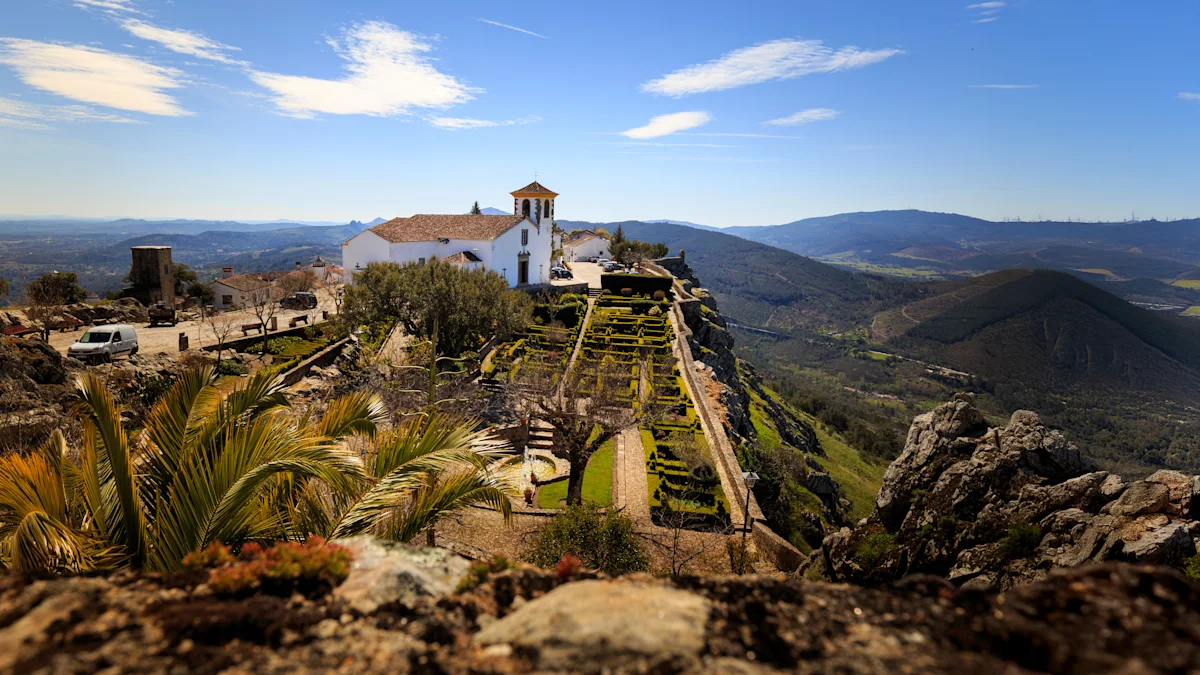
Our day begins with a tour of Castelo de Vide, a prominent medieval fortress commanding a high point far above the vast Alentejo landscape. The views from the castle walls are stunning, while the town below holds a well-preserved Jewish Quarter with cobbled streets and a synagogue. Then head to nearby Marvao, a small village perched on a quartzite crag that marks the highest crest of the Serra de Sao Marmede. Just a stone’s throw from the border with Spain, the picturesque town offers a 360° panorama of the surrounding countryside into both countries. Given its elevation atop a mountain marked by steep slopes on three sides, Marvao held strategic importance in the region for centuries, with a castle of its own for defense. Inside the town walls are narrow lanes lined with houses that exude centuries of architectural heritage, from Gothic arches and Manueline windows to wrought-iron balconies and other embellishments in the nooks and crannies of the buildings made from local granite.
After lunch in Marvao, continue to Galegos for a foray into the history and contemporary production of Portuguese olive oil. Take a journey through the entire process, from cultivating olive trees (some thousands of years old, others new plantings) to harvesting the olives and the evolution of extraction methods, contrasting the old lever presses with the modern technology of today's industrial presses. Hear about the central role of "Portuguese green gold” in the Mediterranean diet and in Alentejo culture as we learn the difference between the various types of olive oil (virgin, extra virgin, etc.) and the factors that influence their flavor and quality. During a tasting, we’ll learn to identify different sensory attributes (fruity, bitter, and spicy), similarly to a wine tasting.
Return to Crato to participate in a pottery workshop, offering firsthand insight into a centuries-old craft that is a vital part of Alentejo's cultural identity. The use of earthenware vessels in the region dates back to Neolithic times, with elements of the craft passed down through generations of master potters. We’ll learn traditional techniques for working with the area’s characteristic red clay, including how to use a potter's wheel; shaping various items like mugs, bowls, and pitchers; firing in the kiln; and applying glazes. Come away not only with your own creation, but a deep appreciation for the heritage and expertise of local artisans who keep traditional Portuguese ceramic-making alive as a form of durable and functional art.
Day 5: Enter Portugal’s highest mountains and their centuries-old herding villages
Walk medieval Vila Velha de Rodao along the Tagus River with a local guide
Follow the Mondego Walkways past riverside water mills once used to grind grain
Gather with your hosts for a wood-fired dinner at a mountain farm surrounded by lavender
Today we transition from Alentejo to the Serra da Estrela region for an in-depth encounter with Portuguese mountain culture. Stop en route in Vila Velha de Rodao, a medieval village on the Tagus River, for a guided walk and lunch. Continue into Serra da Estrela Natural Park, Portugal’s largest protected area, which contains the country’s highest mountain peaks. Our scenic drive takes us through centuries-old sheep-herding communities to our ultimate destination today, the high-country village of Videmonte, located in the heart of the Serra da Estrela conservation area. The region is very important to Portugal's biodiversity, with its altitude and geographic isolation resulting in a wide variety of distinctive flora and fauna. The lower slopes of the granite mountains are forested in oak, pine and chestnut trees with the occasional rare yew, along with junipers, laurel and bellflowers, while the glacier-scoured valleys hold heather, rosemary and brooms. And though we won't see these larger species, it's exciting to know these mountains shelter wildlife, including wolves, boars, otters, foxes and more.
Explore our wild environs on a scenic amble over the Mondego Walkways—a 7-mile network of wooden boardwalks and bridges along and above the Mondego River through the UNESCO Estrela Geopark. One of the most fascinating aspects is the old water mills that dot the riverbanks, some of which date back centuries. They were once vital to local communities as the primary means for grinding grain into flour, and many of these charming old structures have been beautifully preserved.
Nearby, a very special accommodation awaits: Terra Sense Retreat & Farm, a property comprising two modern luxury villas constructed of local materials built on a family-owned farm surrounded by lavender fields. A boutique property like this, where we feel as though we are guests at a private home, is only available to a small group like ours—you won't find big bus tours anywhere in the Serra da Estrela region, for that matter. This evening, gather for a traditional wood-fired dinner with our hosts.

Day 6: Bake bread and make mountain cheese with the people of Videmonte
Join a village baker to prepare rye bread in the communal wood-fired oven
Enjoy a cheesemaking workshop, including tastings of famous cheeses from Serra da Estrela
Explore Linhares before a dinner featuring fine local farm-to-table fare
Tucked into a river valley surrounded by Portugal’s tallest mountains, Videmonte is a small community known for its legendary hospitality. According to local lore, the village was formed when a rich nobleman, whose land was called Monte, welcomed the struggling people of the nearby hamlet of Vide, where he attended Sunday mass, to come share in his bounty. Today, the rules of a good host in Videmonte dictate that there is no shortage of water or bread for those who visit the village. Flowing fountains are found throughout the cobbled streets, and breadmaking—from the growing and harvesting of rye, to the flour milling and baking in a wood-fired oven—continues the ancestral traditions of this place, along with the cultivation of chestnuts and potatoes.
To this day, the picturesque town of some 500 residents is known for its hospitality and communal nature. We experience these values ourselves as we meet local people and gain uncommon insight into their daily lives and enduring traditions in a highly personalized context. Join a baker for a bread-making lesson using the communal oven, and enjoy a cheesemaking workshop, including tastings of some of the famous cheeses for which the Serra da Estrela region is known. Following a tour of the village, with its schist and granite houses and red-tile roofs, sit down for lunch with community members at the Videmonte Residents’ Association. Then return to our luxurious farm stay for some free time—take a swim in the pool, read on a lounge chair with a fabulous view of the valley, or visit the resident donkeys and goats. Then, it's time to head to Linhares—an ancient town surrounded by an 11th century Templar castle—to explore both before a dinner featuring fine local farm-to-table fare.
Day 7: See how shepherds’ wool becomes traditional burel cloth
Visit a Manteigas workshop to watch wool washed, spun, woven and felted
Settle into Casa de Sao Lourenco, a glass-walled hotel high in the Serra da Estrela
Raise a welcome drink during a private reception overlooking the glacial valley
Following a last fresh breakfast on the farm, depart for Manteigas, a small town in the heart of the Serra da Estrela known for its long history rooted in wool production. Our destination is the 5-Star Casa de Sao Lourenco, our luxury hotel and spa where we spend the next two nights. The property is owned by one of the town’s most prominent burel wool producers, and we stop by his factory and workshop to gain up-close insight into the history of this special mode of wool-making. Burel is a traditional Portuguese boiled wool fabric, particularly known for its use by shepherds in the Serra da Estrela region. It's durable, water-resistant and warm, often described like heavy felt. Burel is made through a unique process of washing, spinning, weaving and then felting the wool, resulting in a dense and robust fabric. After a brief tour (and the opportunity to purchase some of these products yourself), we arrive at the hotel. The interior was crafted by one of Portugal’s most famous designers, and the influence of the local wool-based economy is immediately visible in the furniture and decor. In the evening, enjoy a private reception with welcome drink overlooking the glacial valley below, followed by a group dinner prepared by the hotel’s acclaimed chef.

Day 8: Explore the glacier-carved Zezere Valley beneath the Three Cantaros
Join a guided hike through one of Portugal’s most remote mountain landscapes
Follow the valley to Covao da Ametade, where the Zezere River begins beneath granite peaks
Gather for a farewell dinner featuring Chef Figueira’s contemporary take on regional fare
A full day is yours to spend as you desire at our elegant hotel and spa retreat. Those who wish can join a guided hike this morning to explore the surrounding area, one of the most remote and beautiful landscapes in all of Portugal. If you’d rather take it easy, you’ll have ample time to enjoy the panoramic mountain views from the pool or book a massage at the spa. In the late afternoon, we take a drive through the Zezere Valley, formed by glaciers more than 20,000 years ago. A stop at Covao da Ametade at the head of the valley offers a dramatic view of a trio of imposing peaks known as the Three Cantaros, or three pitchers. The site was originally a glacial meltwater lake, though it was long ago filled in with vegetation as the ice receded. A small stream flowing through the silver beech forest here is the starting point of the Zezere River.
This evening, gather under the stars at the fine restaurant at the hotel for our farewell dinner. Known for the exceptional quality of its dishes and Chef Figueira’s exclusive use of fresh, locally sourced ingredients, the restaurant's hallmark is traditional local fare with a contemporary twist. Enjoy a last chance to share stories of our time together in rural Portugal before tomorrow's return to a bigger, busier world.
Day 9: Depart Portugal after an intimate look at its mountain villages and traditions
Transfer to Porto for homeward flights
An early-morning group transfer back to Porto is provided, where we say our goodbyes and begin our journeys homeward, rejuvenated and enriched from our immersion in traditional Portuguese life.