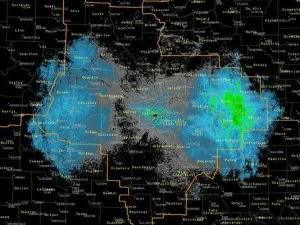
Are They Clouds of Monarchs? Mysterious Unidentifiable ‘Blobs’ Spotted by Radar Over the Midwest

Meteorologists spotted two large ‘blobs’on radars last Friday that cannot be readily explained. Spanning 200 miles and traveling 6,000 feet above the ground, the blobs appeared on radars at the same intensity as a moderately heavy rainstorm does, except that it was dry and clear outside. After considerable speculation, meteorologists hypothesized that the radars must have been spotting a huge flock of migrating monarch butterflies.
The St. Louis Post-Dispatch, opens in new tab reported that the forecasters, who work for the National Weather Service, quickly determined the radars must have been detecting something biological, but the blobs did not match any bird migrations identified on radar in the past.
After researching migration maps and consulting with meteorologists from other offices, the forecasters concluded the radars were most likely detecting monarch butterflies on their southern migration to Mexico. News of what seemed to be a large number of monarchs on the move was well received after recent concerns over the species’dwindling migratory numbers. Over the last few years, monarch populations have fallen to unprecedented low levels. Last winter, monarch numbers at their roosting grounds in Mexico were reported at just 10 percent of their 20-year average.

While there has been considerable consensus in the world of forecasting about the blobs’classification as migrating monarchs, the meteorologists have faced criticism from butterfly experts.
Elizabeth Howard, director of the Journey North monarch conservation project, agrees that the timing is right for the monarch migration but doubts the blobs were actually made up of monarchs. The project has been tracking the migration for two decades and enlists 60,000 people throughout the migration route who report sightings of the small creature. Howard reports that there was no increase in sightings within the region where the blobs were spotted –and the butterflies do have to stop to rest. She also argues that the radar blobs were not the correct shape for flocks of migrating monarchs.
Another butterfly expert, Wendy Caldwell of the University of Minnesota’s Monarch Joint Venture, is also hesitant to agree with the forecasters’hypothesis. While she would be ecstatic if there was a group of monarchs large enough to comprise the 200-mile blobs, she argues that their needs to be more evidence to support such conclusions than inconclusive radar images.

While entomologist Tad Yankoski is not convinced by the sighting either, he actually is optimistic about the blobs, explaining, “A lot of what monarch butterflies do in their migration is still a mystery to people.”Regardless, scientists lack sufficient evidence and consensus to confidently classify the blob as a migrating monarch population. Despite contradictory beliefs concerning the radar sighting, both meteorologists and butterfly experts are hopeful that the blobs did consist of monarchs, as this would show a recovery of the diminishing species. The blob will remain a mystery, however, until further verification may establish consensus among the conflicting experts.
Join us on our journey to Mexico to experience the Kingdom of the Monarchs!