Itinerary
Itinerary
Day 1: Begin your South India journey in the historic Deccan capital of Hyderabad
Arrive in Hyderabad, a historic Deccan capital shaped by Persian, Arabian and South Indian influences
Join your Expedition Leader and fellow travelers for a welcome dinner and an introduction to the adventures ahead
Arrive in Hyderabad, founded in 1591 and shaped by centuries of Deccan, Persian and Arabian influences evident in its architecture and cuisine. You are met on arrival and transferred to The Leela Hyderabad in Banjara Hills. This evening, meet your Expedition Leader and fellow travelers over a welcome dinner. Get an introduction to our route ahead, and gain context for the distinct histories, cultures and landscapes we will encounter on our sojourn across South India.

Day 2: Discover Hyderabad’s royal heritage and home cooking
Explore the Charminar, Laad Bazaar and Chowmahalla Palace in Hyderabad’s old city
Visit the traditional pearl market, then share a home-cooked lunch with a local family
Walk among the Qutb Shahi Tombs, where Persian, Afghan and Indian architectural influences meet
Get to know Hyderabad today, one of the largest and wealthiest of India's former princely estates. The city built its fortune on international trade in pearls, gold, cotton fabric and above all, diamonds. Once the most famous diamond mining area in the world, this is where the 108-carat Koh-i-Noor diamond, as well as the Orloff, Regent and Hope diamonds, were excavated. Today, Hyderabad is known for its burgeoning information technology and biotech research industries, although our focus is on its historic identity. With our Expedition Leader, we explore the old city on foot, beginning at the Charminar, a grand icon of Hyderabad built in 1591 under Sultan Muhammad Quli Qutb Shah.
Continue through the Laad Bazaar, a vibrant emporium especially famous for its bangle bracelets, as merchants open for the day, then visit Chowmahalla Palace, once the seat of the Asaf Jahi dynasty. We also visit the traditional pearl bazaar, where pearls are still sold alongside attar, textiles, footwear and Hyderabad sweets. At midday, a local family welcomes us into their home for lunch, introducing us to the local cuisine influenced by Mughal, Turkish and Arabic traditions. Later, visit the Qutb Shahi Tombs, a royal necropolis combining Persian, Afghan and Indian architectural influences on display in the magnificent monuments built in the 16th and 17th centuries.
Day 3: Step into the magnificent ruins of the Vijayanagara Empire
Fly to Hubli and continue to Hampi through the granite boulder landscapes of the Deccan Plateau
Discover the Vittala Temple complex and its famed stone chariot
Watch evening light illuminate the temples and boulder fields of the former imperial capital
Fly to Hubli this morning, then continue overland toward Hampi as the Deccan Plateau transitions to the immense granite boulder fields that dominate the region. From the 14th through the 16th centuries, Hampi was the opulent capital of the powerful Vijayanagara Empire. At its peak around the year 1500, it was one of the largest, wealthiest and most populous cities in the world, with roughly half a million people, attracting traders and travelers from Persia and Portugal. More than 1,600 monuments survive from its heyday, and the remains of those grand temples, royal compounds, canals and reservoirs span the landscape along the Tungabhadra River.
Once we're situated at our hotel, we head out to explore the Vittala Temple complex, a 15th-century architectural masterpiece dedicated to Lord Vishnu, famous for its enormous carved stone chariot and 56 musical granite pillars, each resonating with an individual musical note or sound imitating traditional Indian instruments. We end the afternoon at a viewpoint overlooking the remains of the former capital as golden light illuminates the ruins and surrounding boulder fields.

Day 4: Learn about cultural conservation in the village of Anegundi
Cross the river in a traditional coracle to enter the landscape identified as Kishkinda in the Ramayana epic poem
Travel through rice fields and banana groves as you hear tales of Rama and Hanuman
Join Kishkinda Trust founder Shama Pawar to learn about her community conservation work over lunch in her walled garden
Board a traditional coracle—a round, flat-bottomed watercraft used in South India to transport people and goods—to cross the Tungabhadra River. On the opposite shore, travel through rice and banana fields into a landscape described in the Ramayana, one of India's most famous Sanskrit Hindu epic poems, which chronicles the life story of Prince Rama. The terrain we have entered is called Kishkinda, the monkey kingdom where Rama meets Hanuman, the divine half-human, half-monkey god. Caves, prehistoric rock art and distinctive rock formations appear throughout the area as our Expedition Leader shares the colorful stories and myths associated with these hills and waterways.
In the Hampi village of Anegundi, we meet Shama Pawar, founder of the Kishkinda Trust, which works to support and empower local residents through the preservation of cultural traditions including crafts and design, architectural conservation, and environmental protection. Learn about this community-based work firsthand before joining Shama for lunch in her walled garden amid the boulders and banana groves of this historic village.
Day 5: Greet the sunrise and explore Hampi’s sacred living traditions
Climb Matanga Hill before dawn to watch sunrise over Hampi’s temples and boulder-strewn hills
Follow the ancient bazaar to Virupaksha Temple and take part in a Hindu puja
Ride in a coracle on the Tungabhadra River, then gather for sunset drinks on the riverbank
Rise early and depart before sunrise on a moderate 20- to 30-minute ascent of Matanga Hill. From the summit, take in a magnificent 360° panorama encompassing the Tungabhadra River, temple towers, the abandoned city of Vijayanagara, and the boulder-strewn hills below in the exquisite first light of morning. After descending, continue past a monolithic statue of Nandi, the sacred bull mount and attendant of the Hindu god Shiva, and along the ancient bazaar to Virupaksha Temple, part of the Monuments of Hampi UNESCO World Heritage Site. Functioning continuously since the 7th century, it remains an active place of Hindu worship. During our visit, we take part in a puja, a worship ritual offering devotional homage to deities, providing a more meaningful encounter beyond the mere viewing of the monument.
After some time to rest, we visit Hampi’s Royal Enclosure, the fortified administrative, residential and ceremonial seat of power for the Vijayanagara Empire. At its height, the walled enclave contained more than 45 buildings across a 635,000-square-foot space. Late this afternoon, return to the Tungabhadra River for another perspective on the landscape, drifting slowly in a round bamboo coracle before gathering for drinks on the riverbank as evening falls.
Day 6: Karnataka history and daily life, from fortress walls to market stalls
Explore Chitradurga Fort’s massive defense structures with a local guide
Hear the story of solo warrior Onake Obavva, Karnataka’s best-known folk heroine
Browse Mysuru’s Devaraja Market filled with flowers, produce, perfumes and puja offerings
Today’s long drive south to Mysuru is broken by a visit to Chitradurga Fort, a sprawling stone complex built atop a set of rugged hills. Surrounded by seven concentric stone walls, the fort covers around 1,500 acres, with 19 gateways and 2,000 watchtowers. Ingenious rainwater harvesting systems ensured a steady water supply even during long sieges, making the fort almost impregnable. Explore its massive lower fortifications with a local guide who shares the story of Onake Obavva, a brave warrior folk heroine who famously defended the fort single-handedly against invading forces, using only a pestle.
After lunch, continue to Mysuru, famous for its royal heritage and magnificent monuments, including the elaborate Mysuru Palace. We head directly to Devaraja Market, a flamboyant street bazaar of stalls heaped with bananas, coconuts, vegetables, flowers, spices and puja offerings, with perfume sellers and small shops lining the surrounding lanes. Our Expedition Leader and local guide lead us through sections of the sprawling site of commerce that visitors could easily overlook, before we continue to our heritage hotel.

Day 7: Mysuru’s royal legacy, cooking practices and silk traditions
Tour Mysuru Palace’s lavish halls and ceremonial spaces while learning about the Wadiyar dynasty
Join a local hostess in her home to prepare and share a meal using seasonal ingredients and Mysuru cooking techniques
With a textile specialist, follow silk production from silkworm cocoons to loom weaving
Mysuru Palace is our focus this morning. Drawing more visitors than almost any other site in India except the Taj Mahal, this extravagant royal residence was home to the Wadiyar dynasty in the early 20th century. When a fire destroyed the earlier wooden palace, British architect Henry Irwin was commissioned to design a permanent stone replacement. Blending Hindu temple motifs, Islamic domes and arches, Rajput balconies and Gothic detailing in a mix historians call Indo-Saracenic architecture, the current palace took 15 years to complete. Exquisite details include arched colonnades, filigreed screens and richly carved wooden doors scattered across the facade. The palace complex is surrounded by 72 acres of manicured gardens, fountains and pathways,
At midday, a local hostess welcomes us into her home for an interactive cooking session and lunch. She introduces seasonal ingredients and techniques used in Mysuru cooking as we prepare and share a meal together. This afternoon, we get a close-up look at Mysuru's longstanding tradition of silk production. The Karnataka region's association with sericulture dates to the 18th century, when Mysuru's Tipu Sultan was gifted exquisite silk cloth from the royal court of the Qing Dynasty in China. Entranced by the lustrous fabric, Tipu send a delegation of courtiers to Bengal and China to collect silkworms for breeding. Mulberry leaves were cultivated for silkworms to feed upon, and within a century, Karnataka became the top producer of silk in India, a status it still holds today. With a silk textile specialist, we visit a village where silkworm cocoons are raised and harvested, then follow the process through dyeing and spinning before the thread reaches the loom.
Day 8: Enter the forests of the Western Ghats and look for wildilfe
Look for elephants, spotted deer and langurs as we drive through Bandipur Tiger Reserve
Ascend into the Western Ghats as dry forest gives way to Wayanad’s tropical evergreen vegetation
Join a naturalist-led night walk to search for frogs, insects and reptiles in the rainforest
Our road to Kerala passes through Bandipur Tiger Reserve, part of the Nilgiri Biosphere Reserve and one of India’s important wildlife corridors. We cannot stop within the reserve, but we watch from the vehicle for elephants, spotted deer and langurs, with other wildlife possible though never assured. Beyond Bandipur, dry forest gradually gives way to increasingly moist vegetation as we climb into the Western Ghats to eventually reach tropical evergreen forest.
Our base for the next two nights is CGH Wayanad Wild, a rainforest ecolodge at approximately 2,300 feet. After lunch and time to relax, head into the forest after dinner with a naturalist guide for a flashlight-illuminated walk, looking for frogs, insects, reptiles and other species most active after dark.

Day 9: Wayanad—Rainforest trails, wildlife, tea, coffee and spices
Hike through tropical evergreen forest, listening for bird calls and watching for signs of wildlife
Taste locally grown tea and tour a coffee plantation where pepper and cardamom grow beneath the shade canopy
Discover the surrounding forest’s wildlife through remote-camera images and insights from the lodge’s resident naturalist
Set out early for a moderate hike through tropical wet evergreen forest, walking beneath massive old trees while bird calls and other signs of forest life surround us. After breakfast, visit Harrison Malayalam Tea Estate, following tea production from plucking leaves through withering, rolling, fermentation and drying, then taste the finished product. Then turn to coffee and spices: At Moovatty Coffee Plantation, robusta coffee beans grow beneath a shade canopy while pepper vines climb tree trunks and cardamom grows below. After lunch at the estate, walk through the plantation and visit its drying, pulping and storage areas.
Back at Wayanad Wild, join the resident naturalist for an evening session using remote-camera images and field observations to better understand the wildlife that shares the surrounding forest.
Day 10: Wayanad / Kozhikode / Alappuzha / Kumarakom—Across Kerala by Rail
Descend from the Western Ghats through winding mountain roads to Kerala’s coastal plain
Board the Vande Bharat Express and watch paddy fields, towns and coconut palms pass outside our windows
Arrive in Kumarakom and settle in to your lakeside retreat
Leave Wayanad early, descending from the Western Ghats through hairpin bends as rainforest gives way to Kerala’s lower country and coconut groves.
Time permitting, stop briefly in Kozhikode for a taste of Malabar breakfast specialties before boarding the Vande Bharat Express. Traveling south in air-conditioned Executive Chair Car, watch paddy fields, towns, coconut palms and glimpses of water pass outside the windows.
Disembark at Alappuzha and continue after lunch to Kumarakom Lake Resort on Vembanad Lake. Later this afternoon, there may be time to walk toward the nearby Kumarakom Bird Sanctuary or simply enjoy the hotel.

Day 11: Cruise village waterways and row with a snake-boat crew
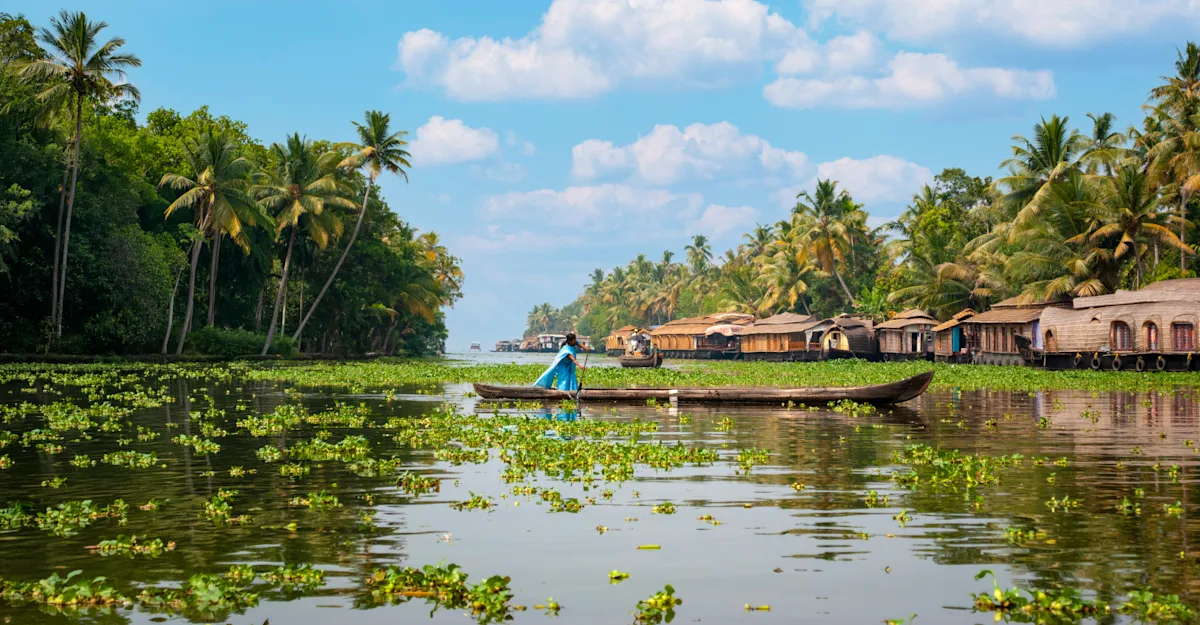
Travel Kerala’s lakes and canals aboard a traditional kettuvallam houseboat, passing waterfront villages and enjoying lunch on board
Paddle alongside a local snake-boat crew, then share coconut water or chai while learning about their village boat club
Board a traditional kettuvallam houseboat from the hotel jetty and enter Kerala’s network of lakes and canals. Travel through backwater villages, stopping where possible to step ashore and see communities linked by water rather than roads. Lunch is served aboard.
Later, meet a local chundan vallam crew and learn about Kerala’s village snake-boat tradition. These racing boats can stretch approximately 100 feet, with large crews paddling in rhythm to vanchipattu, traditional songs that set the stroke.
After learning the basic technique, take a place alongside the local rowers for short bursts of paddling. Then share coconut water or chai with the crew while learning about the village boat clubs, the people who race for them and life outside competition season.
Day 12: Meet the families who farm and fish Kerala’s backwaters
Navigate narrow canals by shikkara and meet a family preserving the rare tradition of barehand fishing
Walk earthen embankments with a farmer to learn how Kuttanad’s rice fields are cultivated below the surrounding water level
Share a farming family’s lunch overlooking the fields before gathering for farewell drinks and our final dinner together
Leave the wider waterways behind and enter Kerala’s narrower canals by shikkara. These channels once carried rice, coir, copra and spices toward the coast and still pass homes, farms, coir yards and small settlements.
Meet a family that continues the increasingly rare practice of barehand fishing. Watch the fisherman work in shallow water without nets or hooks, then sit with the family to learn how the skill is passed between generations.
Continue into Kuttanad, where farming relies on an engineering system that holds water back from fields lying below the level of the surrounding lake and canals. Walk an earthen bund with a farmer, with rice fields below on one side and higher water on the other.
Lunch is hosted by a farming family overlooking the fields, featuring ingredients tied directly to the surrounding landscape. Return to the resort this afternoon before a farewell drink beside the lake and our final dinner together.
Day 13: Depart Delhi after your South India journey
Fly from Kochi to Delhi, where a day room offers time to rest and freshen up
Transfer to the international airport this evening for departing flights
Transfer to Kochi Airport this morning for our flight to Delhi. On arrival, continue to Roseate House, where a day room is available until departure. There is time for lunch, rest and a chance to freshen up before our late-evening transfer to the international airport for flights home.