“Thar They Blow”: Blue Whales Surface en Masse in Monterey Bay
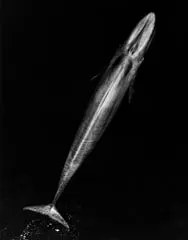
When my son and I visited California’s Monterey Bay in October a few years ago, we were enchanted by our frequent sightings of sea lions and sea otters. This experience seems quaint compared to that of Monterey Bay visitors this summer, where an upwelling of krill has attracted a sensational number of blue whales, the largest creature known to have ever existed on earth.
Blue whales normally feed off the Pacific Coast from Alaska to California in the summer; a mini-industry exists to take customers on whale-watching cruises. Unusual this year is the quantity of whales and their close proximity to shore. An article in the San Jose Mercury News from July 2 reported that there were an estimated 100 blue whales in the bay. Normally, blue whales do not gather in groups like other baleen species. With a single whale’s capacity to eat more than 7,000 lbs of krill per day, their food supply in Monterey Bay this summer must be truly prodigious.
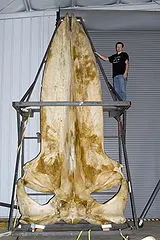
Blue whale calves can weigh in at a robust 6,000 pounds at birth. They grow rapidly, gaining as much as 200 pounds a day during their first year. An adult can be 98 feet in length and weigh approximately 200 tons, with its tongue alone weighing up to three tons! This species was, of course, a prized catch for whale hunters, and the blue whale was nearly hunted to extinction before a ban was imposed in 1966 by the International Whaling Commission. Today, estimates of the worldwide blue whale population range from 5,000 to 12,000, with the largest known concentration at 2,000 to 3,000 in the northeastern Pacific from Alaska to Costa Rica. Before the whale hunting boom of the early 20th century, it is estimated that there were 200,000 to 300,000 blue whales in the Antarctic region alone.
The only known natural predator of the blue whale is the orca, and scientists are uncertain how often these are actually successful in killing their much larger prey. A more clearly identified threat to the blue whale these days is giant cargo ships, which, when they strike a whale, often break the animal’s vertebrae. Other threats include the increasing use of sonar by marine vessels, and the accumulation of PCBs in the whales’ bodies. If massive glacier melt occurs due to warmer climates worldwide, scientists suspect that an increase of fresh water pouring into the oceans may shift the location and abundance of krill and the whales’ migration patterns.
The convergence of giant whales and tiny krill in Monterey Bay this summer before a human audience of thousands will hopefully increase widespread appreciation for nature’s surprising and fragile connections.
Experience the giant creatures of the sea on one of Natural Habitat’s marine adventures! Our Mexico whale watching trip will introduce you to the gray whales migrating along the Baja peninsula, while our San Juan Islands whale watching tour provides close-up encounters with orcas, sea lions, seals, otters, and more!