Let a baby polar bear capture your heart!
I may be one of the few people on the planet – with access to television, at any rate – who had never seen footage of the baby polar bear orphan Knut until a few days ago. Though I had heard of this global celebrity that captivated the world a couple of years ago when he was raised from infancy by a Berlin zookeeper, I hadn’t actually followed his story.
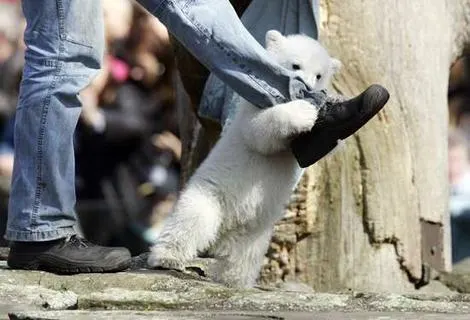
It wasn’t until I watched the documentary “Knut and Friends” (December 2009) with my daughter that my heart joined the millions already stolen by this adorable fluffy white polar bear cub. Knut is now 3-1/2 years old and fully grown, but the mania that accompanied the media tracking of his first year probably did more to catapult polar bears onto the world stage than all the global warming news coverage with its implications for the polar bears’ plight.
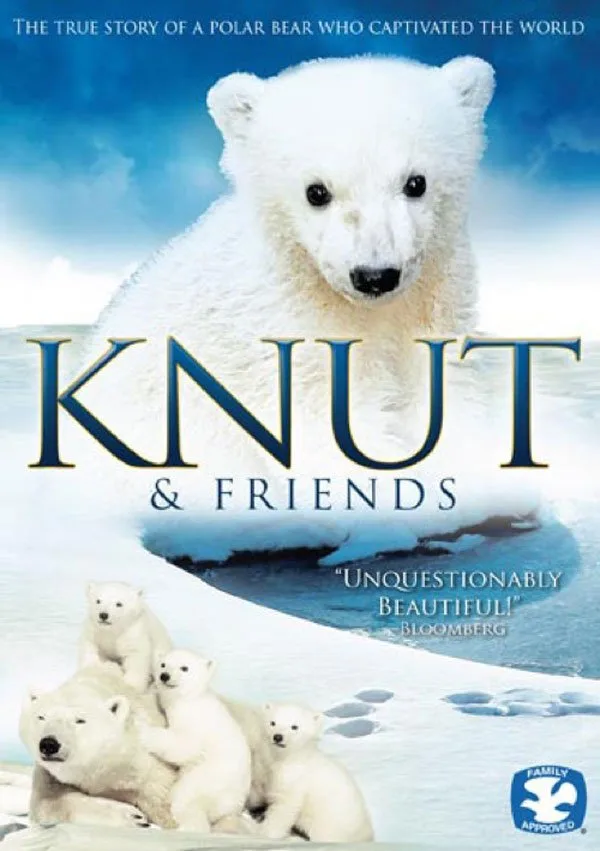
The film tells the story of Knut, born in captivity to a retired circus bear who rejected him at birth. He was raised by hand by his beloved keeper and surrogate parent, Thomas Dorflein, who sadly died of a sudden heart attack in September 2008 at age 44. I watched, enrapt and delighted, as Knut sucked down baby bottles of “formula” mixed with cat food and cod liver oil, took his first clumsy steps, learned to swim, and trailed Dorflein around the zoo like a puppy.
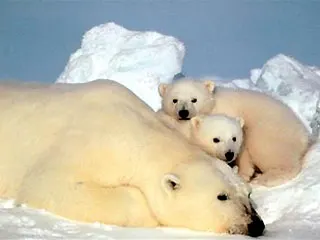
The documentary also interweaves two other riveting bear stories. It follows a mother polar bear who gives birth to triplet cubs in the Arctic wild, tracking their difficult journey from remote den to the edge of the pack ice and the season’s first meal for mama, who has been fasting for more than four months. Along the way the smallest and weakest cub dies, unable to compete with his brother and sister for food and weight gain. There’s also the story of two orphaned brown bears in forest of Belarus, just 5 months old and learning to fend for themselves after the death of their mother.
The viewer comes away with a new appreciation of just how challenging it is for young bears to survive and thrive in the wild, especially for the polar bear, whose vulnerable habitat is forcing it to adapt to shifts in its millennia-old hunting patterns as the sea ice freezes later and melts earlier, shortening its traditional seal-feasting season.
As these stories are interspersed with the heartwarming footage of Knut’s first 18 months, one can’t help but be moved all the more deeply to care about the conservation of polar bears. And while it was magical to watch baby Knut grow up on the screen, there is nothing to compare with seeing polar bears in their wild home, as my family was so fortunate to do last November in Churchill, Manitoba, opens in new tab.
We saw several mothers with cubs, who at this point were robust half-yearlings, ready to learn to hunt on the pack ice for themselves. And, as in the film, we watched pairs of young males play-fighting, providing better entertainment than even the best nature documentary could offer, since we were right there before them on the tundra.
If you’re one of the few who came late to Knut’s story, as I did, by all means see Knut and Friends. Even better, give yourself the peak experience of seeing polar bears in their natural habitat. Nat Hab’s new polar bear website, opens in new tabis a great place to start.