“Extreme Melt” Observed on Greenland Ice Sheet

One of the most enticing places on the planet for adventure kayakingis Greenland. The combination of extraordinary scenery, traditional culture and a truly remote setting offer explorers a peerless immersion in the Arctic wilderness. In recent years, ice melt due to global warming has opened up new areas for kayaking along Greenland’s coast, creating some exciting exploratory expedition opportunities for us, such as our paddling trip that departs in a few days for Kangerdlussuaq Fjord.
But new data that shows the melting of Greenland’s ice sheet accelerating dramatically has us concerned.
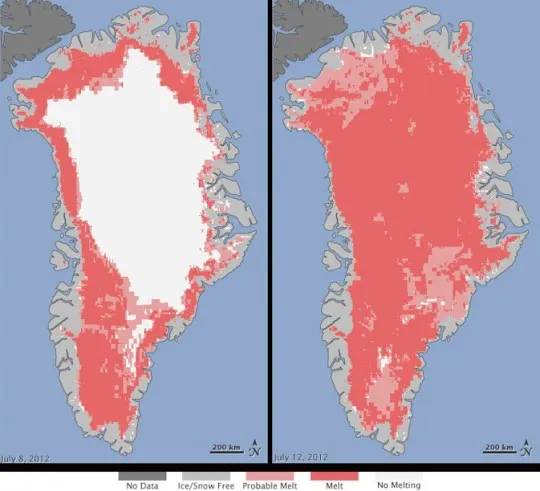
For several days this month, Greenland’s surface ice cover melted over a larger area than at any time in more than 30 years of satellite observations, according to new NASA data, opens in new tab. Nearly all of Greenland’s vast ice cover of Greenland, from its thin coastal edges to its two-mile-thick center, experienced some degree of melting at its surface, according to measurements from three independent satellites analyzed by NASA and university scientists.
The satellite measurements showed that on July 8, about 40 percent of the ice sheet had experienced thawing at or near the surface. By July 12, the melting had accelerated so rapidly that an estimated 97 percent of the ice sheet surface had thawed to some degree.
Scientists analyzing the satellite radar data that monitors Greenland’s ice sheet found the observations so dramatic that initially, some questioned whether what they were seeing was real or the result of a data error, according to the NASA report, opens in new tab.
During a typical summer, according to NASA, about half of the surface of Greenland’s ice sheet experiences melting. At high elevations, most of that melt water quickly refreezes in place while near the coast, some is retained by the ice sheet and the rest enters the ocean. This year, however, the extent of melting has essentially doubled.
Researchers have witnessed that the extreme melting event coincides with a “heat dome” — an exceptionally strong ridge of warm air — that settled over Greenland during the mid-July period of accelerated melting. Several such successive ridges of warm air have dominated Greenland’s weather since late May, with each becoming stronger than the last, according to Thomas Mote, a climatologist from the University of Georgia-Athens who monitors satellite data on Greenland’s ice.
Glaciologists studying the phenomenon note that such major melting events have happened cyclically in Greenland’s past, with the last one occurring in 1889. So this one is “right on time,” says Lara Koenig, a glaciologist with NASA’s Goddard Space Center quoted in a NASA Earth Science Team news release, opens in new tab. But a warming planet could mean that such events will happen more frequently, and if that is the case, “it will be worrisome,” says Koenig.
To learn more about Greenland melting and get additional news about the condition of the earth’s polar ice, visit the website of the National Snow & Ice Data Center, opens in new tab.
Yours in the care of our planet,
Wendy